



“The bull market, in the classic way of bull markets, had begun to lead a happy and profitable life of its own, independent of underlying reality.”
In 1968, two future titans were planning on bringing a hot issue to market. The company, EDS, was led by American Dream poster-child Ross Perot, and its investment banker was a young Kenneth Langone, then of R.W. Presspitch and Company.
Ross Perot was a stock promoter’s dream. EDS was effectively a government subcontractor making money selling computerized systems that administered state Medicare programs at a considerable mark-up. The business model belied Perot’s professed love of “free markets,” but his homespun rags-to-riches storyline and drumbeat of aspirational optimism made him a larger character than the company itself. In 1969, EDS had just $1.5 million in earnings, but that was no hang-up for a stock market hungry for new shares and the stories that could sell them.
The S&P 500 traded around 16 times earnings, at a market multiple EDS would have been valued around $25 million dollars, but Langone had a more audacious plan. Langone suggested issuing 11.5 million shares at an agreed upon price of $16.50 per share, nearly 120 times earnings, a $1.8 billion valuation.
The absurd valuation would be supported, Langone explained, by the investment banks that would bring the shares to market. But more importantly, the float would be limited to just 650,000 shares -- 325,000 of company shares, 325,000 of Perot’s personal ownership, with the remaining held by EDS employees and Perot himself.
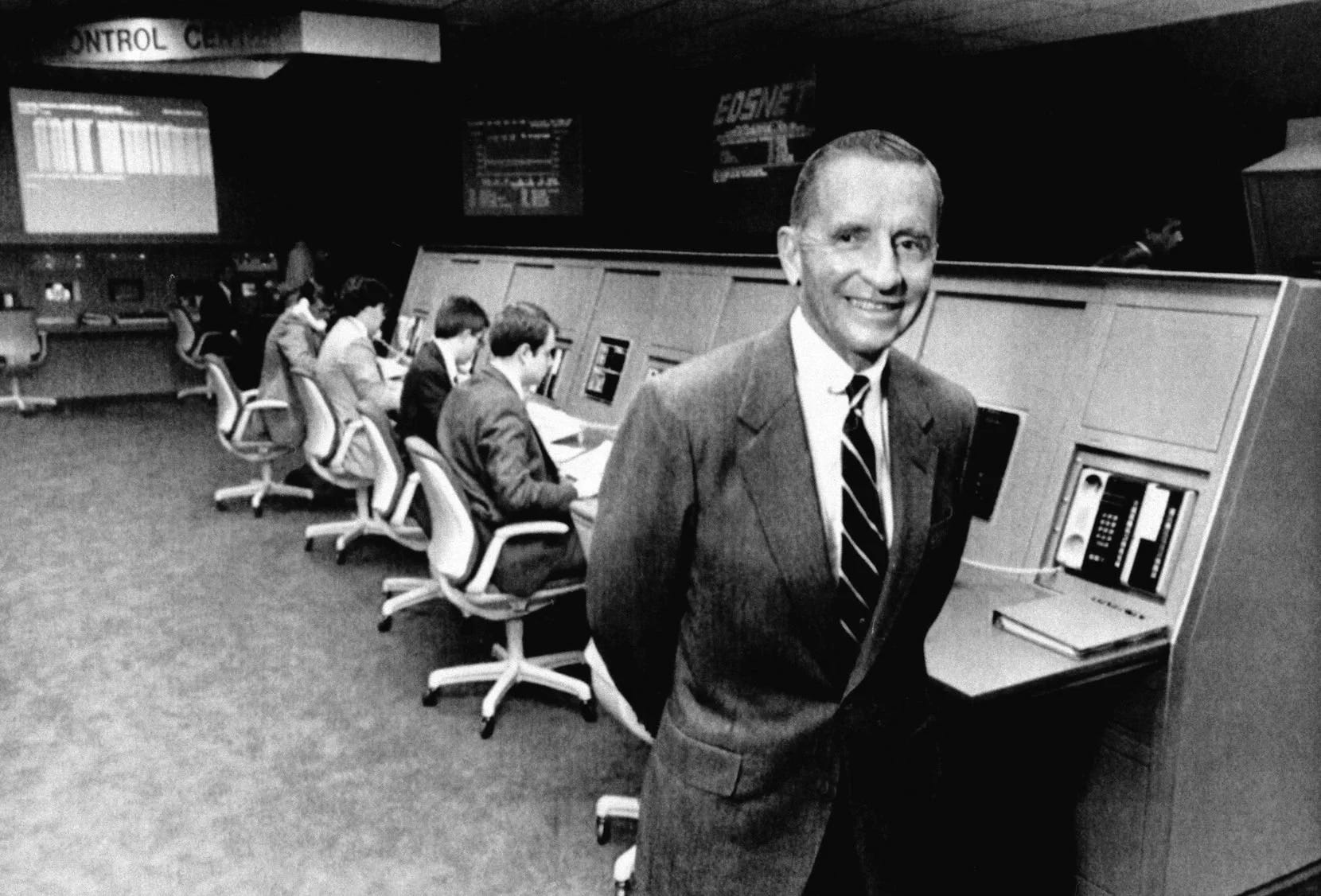
The offering was an instant success, the shares were gobbled up by investors all over the world, and especially appealing to the high-growth mutual funds of the day.
As John Brooks writes in The Go-Go Years,
“At last, in early 1970, EDS sold at 160. Perot, with his 9-million-plus shares, was now worth on paper almost $1.5 billion-- which, it happens, is about 40% of the whole United States federal budget for 1930, the year he was born.”
Every bull market is the same…
As investors reach for historical analogs to our current moment, the echoes of the 1960s remain largely unexamined. Every generation of investors believes its bull market is different. That the companies are real, the growth is durable, the valuations are warranted. The 1960s were no different. What follows is an account of how that belief was built, and how it came apart.
Akin to our fading memories of 2008, stock market participation in the 1960s had expanded considerably as those who lived through the crash of 1929 were replaced by a new generation. The market became a cultural touchstone as much as an economic one. Mutual funds, specifically those dedicated to ‘high growth’ companies had, in the modern parlance, democratized speculation.
Where only 3 to 4 million Americans were involved in the stock market during the 1920s, the 1960s estimate reached roughly 31 million. The mutual fund industry, once the province of the Ivy League elite, went mainstream. In 1946, just $1.3 billion was invested in mutual funds; by 1967, that figure had surpassed $35 billion.
Similar to today, a small subset of stocks and companies were both the social and economic foundations for equity markets. The “Nifty Fifty,” a loosely defined basket of premier blue-chip growth stocks like IBM, Xerox and Coca-cola, were treated as one-decision, buy-and-hold forever investments. These companies were seen as having strong business franchises that would earn high returns on capital for the foreseeable future. Valuations stretched accordingly, with price-to-earnings multiples for these names reaching levels that, in hindsight, would prove indefensible.
Then, like now, burgeoning new technologies in the electronics and scientific instrumentation sectors had captured the imagination of investors whose analysis required no faculty with financial statements, merely a belief that any price was fair when the future was being shaped. Brooks writes of the era:
“The bull market, in the classic way of bull markets, had begun to lead a happy and profitable life of its own, independent of underlying reality. The week of Funston’s second warning the Welch Scientific Company of Skokie, Illinois, makers of laboratory equipment, offered the public 545,000 common shares at $28.
It is pretty safe to say that of the people who bought all of the shares on opening day, and those who on the very same day bid the price for them up to $52, only a small minority were well informed about or particularly interested in Welch’s profits or asset position.
What they knew, and all they needed to know, was that at that particular moment in time new issues in the scientific-technical field were like found money, and the man whose broker would be so kind as to cut him in for a few hundred shares could count himself blessed.”
The Big Talking Texan
If the 1960s had a Muskian character it would have been James “Jimmy” Ling, an outsider with a knack for complex deal-making that created the hydra conglomerate Ling-Temco-Vought. Ling brought his initial company, Ling Electric, public in 1955 and literally sold shares door-to-door, even selling stock at a booth at the Texas State Fair. He immediately began a succession of speculative mergers and acquisitions. The smashing together of disparate business lines had a poor track record of success but with enough managerial promotion the strategy could still entice investors.
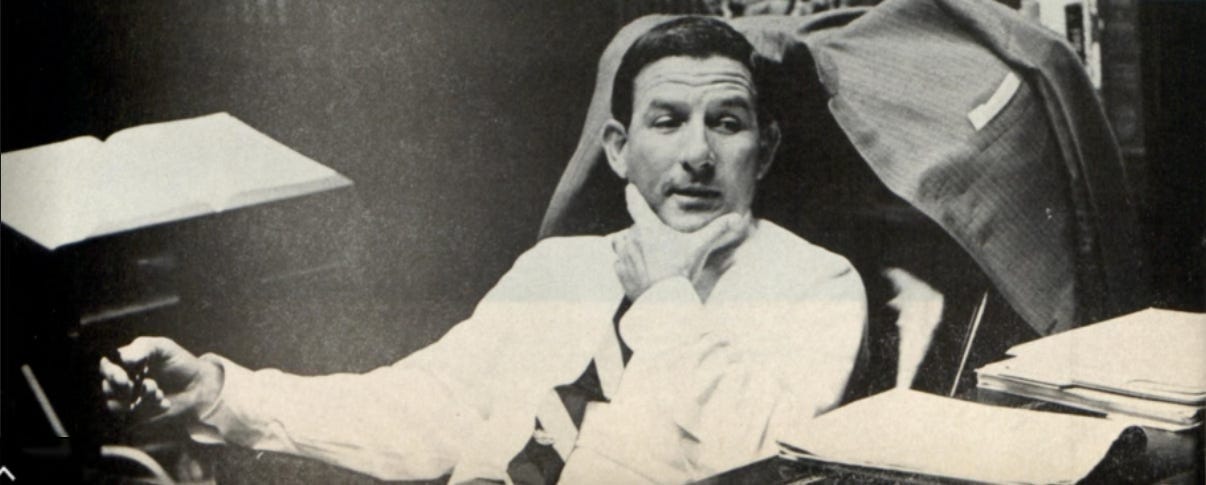
“[Ling’s] deals were so complex, innovative, and ultimately bewildering that to describe them comprehensibly at book length would be a literary tour de force, and to describe them in a few words impossible. In essence, though, they were all geared to the crucial discovery that Ling had made at the Texas fair-that people like to buy stocks and that their overpayments for stock can be capitalized by the issuer to his advantage.”
Ling-Temco-Vought would go on to have the dubious reputation for the longest, most complicated bankruptcy in U.S. history spanning from 1986 to 1993, and eventually filing again in 2000.
Changing Guards
Politically, the shift from the democratic administrations of Kennedy and Johnson, while an endless war raged on, found Richard Nixon in the White House in 1969 facing the specter of recession. The Republican impulse, then as now, was to serve the business community first.
“[T]he beginning of the year 1970 corresponds roughly to the late spring of 1929. In each case, there were warning signals across the land of a coming economic recession, possibly a full-scale depression, and an uneasy Republican administration, only a year or so in office, was wondering what to do for its best friend and principal political client, the business community.”
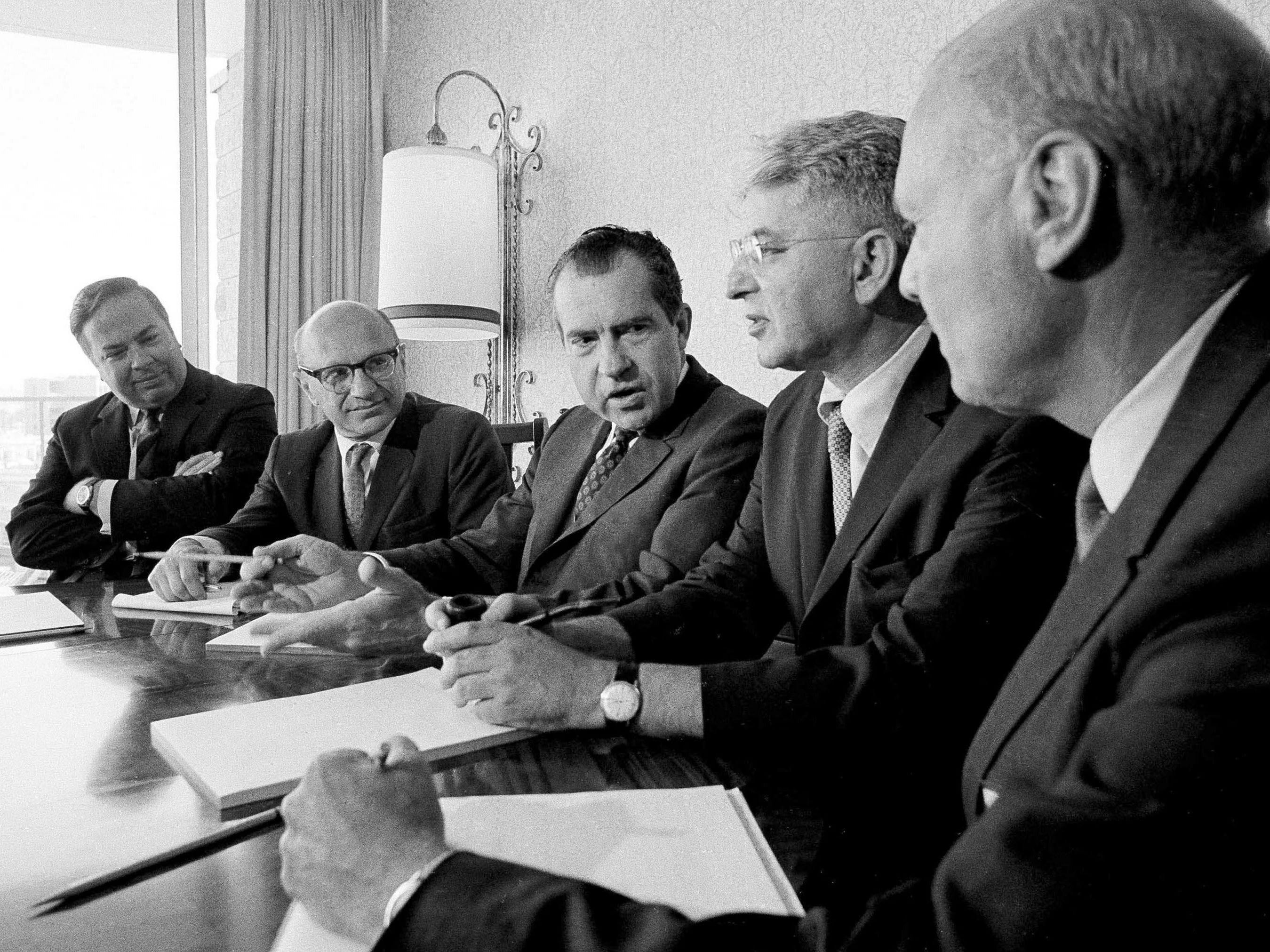
The Federal Reserve experienced a mid-term leadership change from William McChesney Martin, to Arthur Burns who would become the Fed’s perennial cautionary tale:
“In each case a steep decline in second-rank stock issues a sort of hidden crash, since it didn’t show up in the popular averages-was already under way. In each case speculation continued to flourish, and money was historically tight; and in each case the Federal Reserve, torn between trying to dampen speculation and inflation on the one hand and trying to head off recession on the other, was frantically pressing its various monetary levers to little effect.”
For all its eerie similarities in attitude, historical context and quantitative measure, the bull market of the 1960s persisted longer than anyone could have expected. The market climbed the wall of worry, as it so often does, to inflict maximal pain. Brooks,
“And all through the stormy course of 1967 and 1968, when things had been coming apart and it had seemed that the center really couldn’t hold the rising national economic crisis culminating in a day when the dollar was unredeemable in Paris, the Martin Luther King and Robert Kennedy assassinations, the shame of the Chicago Democratic convention, the rising tempo of student riots-the silly market had gone its merry way, heed-lessly soaring upward as if everything were O.K. or would surely come out O.K., as mindlessly, maniacally euphoric as a Japanese beetle in July. Or as a doomed man enjoying his last meal. One could only ask: Did Wall Street, for all its gutter shrewdness, have the slightest idea what was really going on?”
Ultimately, the collision of monetary excess and geopolitical shock created one of the most destructive bear markets in modern history.
In October 1973, following U.S. support for Israel in the Yom Kippur War, Arab members of OPEC imposed an oil embargo on the United States. The effects were swift and severe. The average OPEC crude oil price rose from $1.82 a barrel in 1972 to $11 by 1974. Famously, gas lines formed across American suburbs. Inflation, already elevated, accelerated sharply.
The Dow Jones Industrial Average peaked at an intraday high of 1,051.70 on January 11, 1973, then plummeted to a closing low of 577.60 on December 6, 1974 — a 45% decline over 23 months, the longest bear market in the modern era up to that point. The S&P 500 fared similarly. The index plunged more than 40% by mid-1974, with the damage amplified by the fact that it was dominated by the Nifty Fifty stocks trading at sky-high valuations. When confidence broke, the unwind was savage. Former market darlings like Xerox, IBM, and Polaroid saw their stock prices cut 60–90%.
As for Perot…
On April 22, 1970, Tom Marquez, Perot’s first ever employee and most trusted deputy informed him that EDS stock was down more than 50 points. Such a move gave Perot the honor of experiencing the largest one-day loss of any individual in the stock market to date, losing $445 million in a single trading day. “Later Perot would say that he had felt nothing at all. The event, he would add, had been ‘purely abstract.’” After all, Perot still had a billion or so in residual wealth.
“In the familiar pattern, the investing public, with its thousands rather than billions, had suddenly become interested in hot stocks at the very height of the boom, and had bought E.D.S. near its top...And unlike Perot, those whose bad judgment, or that of their advisers, had led them to make such investments, did not still have a billion dollars left.”
Had the average investor been misled? Not really. EDS’s business fundamentals had remained respectable throughout, there was no obtuse accounting, and Perot himself was honest and earnest, even if occasionally delusional. The limited float Langone had engineered had left investors exposed to more risk, but Presspitch held many more of those same shares.
No epilogue
When the market began to falter, the concentrated institutional ownership of all shares in open-ended mutual funds meant that professional investors had to sell whatever they could to return investor capital. Good and bad companies alike were caught in a liquidity vortex that had been building for more than a decade.
The crash of 1973–74 was the opening act of a prolonged destruction of real wealth that would last the better part of two decades, a slow unwinding that made the initial plunge look almost merciful by comparison.
The numbers are almost difficult to believe. The Dow opened the 1970s at 809 and closed 1979 at 839, a decade of sound and fury that produced essentially nothing for the buy-and-hold investor. In real, inflation-adjusted terms, the damage was considerably worse. The S&P 500 lost nearly half its value across those ten years. The Dow wouldn’t sustainably reclaim 1,000, a level it had first approached in the heady January of 1966, until November 1980. Adjusted for inflation, the cumulative real loss from 1966 to 1982 approached 73%, a figure that rendered the nominal ledger almost beside the point.
The culprit had a name that hadn’t existed in the economic vocabulary before it arrived: stagflation. The toxic marriage of high inflation and stagnant growth should have been theoretically impossible under prevailing Keynesian orthodoxy, which held the two forces in a kind of natural opposition. History was not interested in the theory.
Inflation peaked at 14.8% by 1980, fed by a confluence of forces that had been quietly accumulating for years: Vietnam-era deficit spending, Arthur Burns’ permissive monetary stewardship, the unraveling of Bretton Woods, two separate oil shocks courtesy of OPEC, and a manufacturing base slowly surrendering ground to global competition. The system had been quietly coming apart at the seams for a very long time, and the crash was merely the moment everyone was finally forced to look.
What was learned from the Go-Go Years? Very little, Brooks concludes:
“Rules can be tightened, as many were during the decade and more will be in the future; but as surely as night follows day, the tricksters of Wall Street and its financial tributaries will be ever busy topping the new rules with new tricks, and there is no reason to doubt that the respectable institutions will again play Pied Piper by catching the quick-money fever the next time it is epidemic.”
As Bernard J. Lasker, Chairman of NYSE said in 1972, “I can feel it coming, S.E.C. or not, a whole new round of disastrous speculation, with all the familiar stages in order-blue-chip boom, then a fad for secondary issues, then an over-the-counter play, then another garbage market in new issues, and finally the inevitable crash...”
Lasker issued his warning in 1972, a year before the crash he felt coming. The triggers were his era’s own: an oil embargo, a disgraced president, a Fed asleep at the wheel. They always are. The machinery underneath, however, has a way of reassembling itself with remarkable fidelity. An exasperated Lasker said, “I don’t know when it will come, but I can feel it coming, and, damn it, I don’t know what to do about it.”
One of my favourite books. IMHO better than "Business Adventures"
Not an often reflected period compared to that ‘two decade stretch’, and yet so familiar.